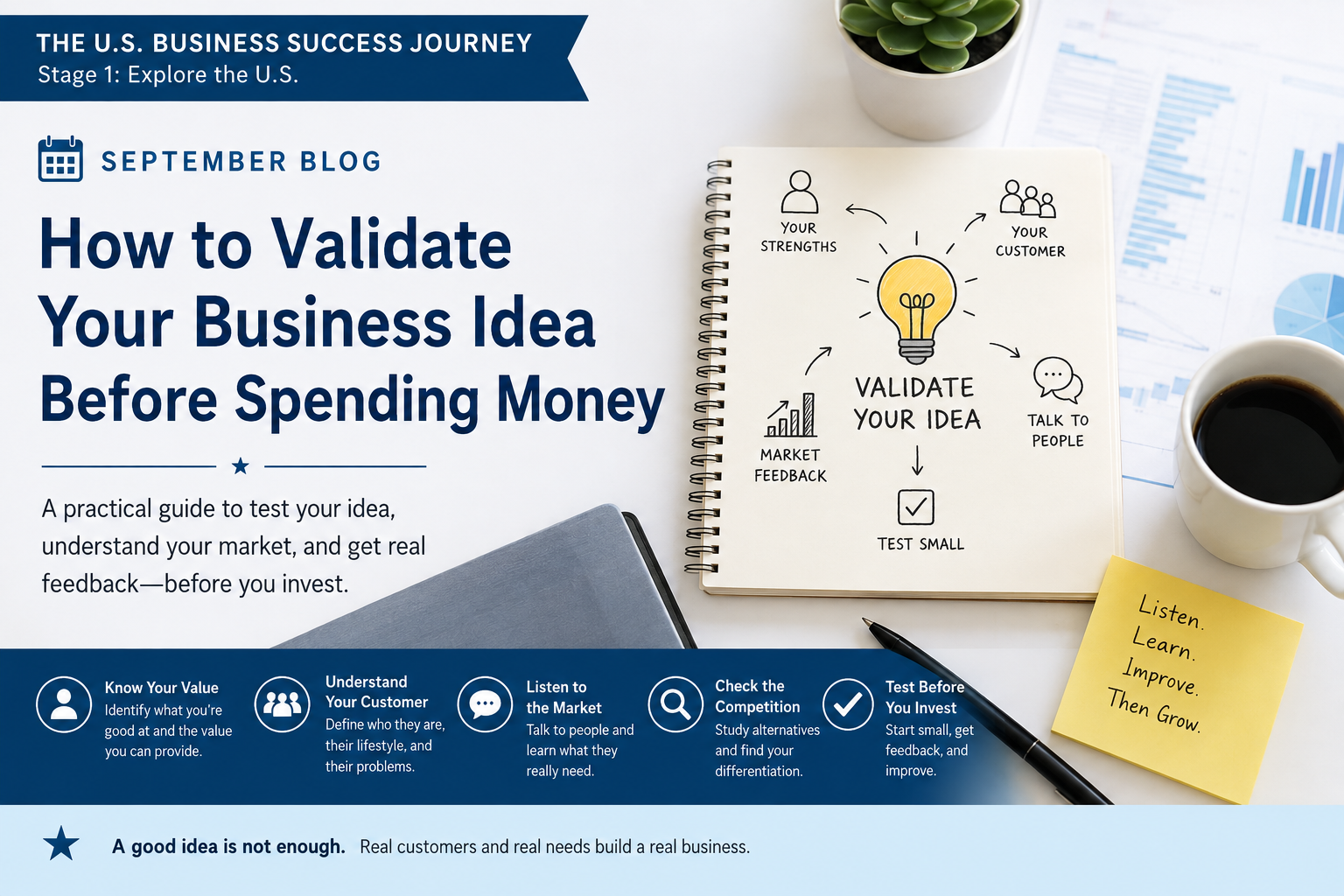
Have a business idea? Learn how to test it, understand your customers, and get real feedback before you invest.
You have a business idea.
Maybe it comes from something you love doing. Maybe people have told you, “You’re really good at this.” Or perhaps you see a problem that you know you could solve. That is a great place to start.
But before you spend money forming a company, building a website, creating a logo, or buying inventory, there is an important question to answer:
Does someone actually want what you plan to offer?
In my last article, 5 Things to Do Before Starting a Business in the U.S., I introduced the importance of validating your business idea.
This month, let’s look at how you can actually do that.
1. Start With the Value You Can Provide
A business idea often begins with you.
What do you enjoy doing? What are you good at? What experience or knowledge do you have that other people may find valuable?
Sometimes we overlook our own strengths because they feel ordinary to us.
Your professional experience, personal background, or knowledge of different cultures may give you a perspective that others do not have.
For example, if you have experience in both Japan and the United States, understanding the differences between the two cultures and markets could become a business advantage.
But identifying your strengths is only the beginning.
A skill becomes a business opportunity when it creates value for someone else.
2. Clearly Define Your Customer
As a CPA, I often hear questions such as:
“Should I form an LLC?”
“Should I incorporate?”
Those are important questions, but they may not be the first questions you need to answer.
One of my first questions is:
Who is your customer?
Try to be specific. What do they do? What does their daily life look like? What problem are they trying to solve? Why would they need your product or service?
For example, suppose you want to start an online Japanese grocery business.
Your customer may not simply be “people who like Japanese food.” Your customer might be a busy Japanese family living far from a Japanese grocery store who wants convenient access to familiar ingredients.
Now you are not simply selling Japanese food.
You are solving a specific problem for a specific customer.
3. Talk to Potential Customers
Once you know who your potential customer is, talk to them before making a large investment.
You do not necessarily need an expensive market research study. Start with conversations.
Instead of asking:
“Do you think my business idea is good?”
ask what they do today, what is difficult, what they wish were easier, and how they currently solve the problem.
People may tell you your idea sounds great because they want to encourage you. That does not necessarily mean they will become customers.
Pay attention to actions as well as words.
Someone asking “How much does it cost?” is more meaningful than someone simply saying “That sounds like a great idea.”
And someone actually buying your product or service is stronger evidence still.
4. Look at the Competition
Finding competitors does not necessarily mean your idea is bad.
In fact, competition may show that people are already willing to spend money to solve the problem.
Look at businesses offering something similar. What do they do well? What do customers complain about? Is something missing?
Then ask yourself:
Why would a customer choose me instead?
Your advantage could be specialized knowledge, better service, convenience, cultural understanding, or focusing on a particular type of customer.
You do not have to be completely different from everyone else. You need to offer something that matters to your customer.
5. Test Small Before You Spend Big
One of the best ways to validate a business idea is to start small.
You may not need a beautiful website, large inventory, office, or expensive marketing campaign to find your first customers.
If you want to offer a service, start with a small number of clients.
If you want to sell a product, consider testing a limited selection before purchasing a large amount of inventory.
If you are considering a class or workshop, try one small event first.
The goal is not to build the perfect business immediately.
The goal is to learn.
What do customers actually buy? What questions do they ask? What are they willing to pay? What would they change?
A small test can give you valuable information before you make a significant financial commitment.
Before You Invest
Before making a significant investment in your business, ask yourself:
- What value am I providing?
- Who is my customer?
- What problem am I solving?
- What alternatives already exist?
- What evidence do I have that customers will actually pay for my solution?
You do not need perfect answers. But if you cannot answer these questions yet, it may be too early to spend heavily on the business.
Final Thoughts
Starting a business is exciting, and it is natural to want to make it feel official.
Forming a company, creating a logo, and designing a website can all make the business feel real.
But those things do not create customers.
Customers create a business.
Before investing significant money, understand the people you want to serve. Listen to their problems. Study the market. Test your idea on a small scale. Then use what you learn to improve it.
You may confirm that your original idea is exactly what the market needs. Or you may discover that it needs to change. Either outcome is valuable because you learned it before making a large investment.
Once you know there is a real customer and a real need, you are in a much better position to make your next business decisions.
Next in The U.S. Business Success Journey:
Should You Start a Sole Proprietorship, LLC, or Corporation?